
Abstract
The population of low vision people increases continuously with the acceleration of aging society. As reported by the World Health Organization (WHO), most of this population is over the age of 50 years and 81% were not concerned by any visual problem before. A visual deficiency can dramatically affect the quality of life and challenge the preservation of a safe independent existence.
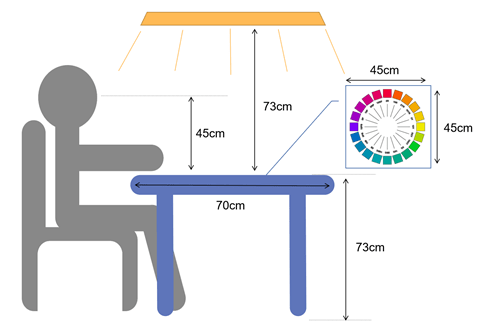
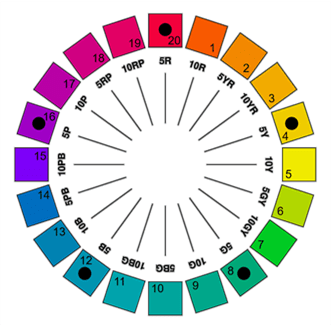
This project presents a LED-based lighting approach to assist people facing an age-related visual impairment. The research procedure is based on a psychophysical experiment consisting in the ordering of standard color samples. Volunteers wearing low vision simulation goggles performed such an ordering under different illumination conditions produced by a 24-channel multispectral lighting system. A filtering technique using color rendering indices coupled with color measurements allowed to objectively determine the lighting conditions providing the best scores in terms of color discrimination.
Experimental results demonstrated that white light obtained by a special mixing of three selected channels can improve the color perception of low vision people in comparison to white LEDs nowadays available on the market for general lighting. Even if additional studies are required to go further, these first results give hope for the design of smart lighting devices that might adapt to the visual needs of the visually impaired.
Reference
Linna Yang, Éric Dinet, Pichayada Katemake, Alain Trémeau, Philippe Colantoni, « A multichannel LED-based lighting approach to improve color discrimination for low vision people » in Electronic Imaging, 2023, pp 253-1 – 253-11, https://doi.org/10.2352/EI.2023.35.10.HVEI-253
 IXR Platform